Generative AI & Higher Education
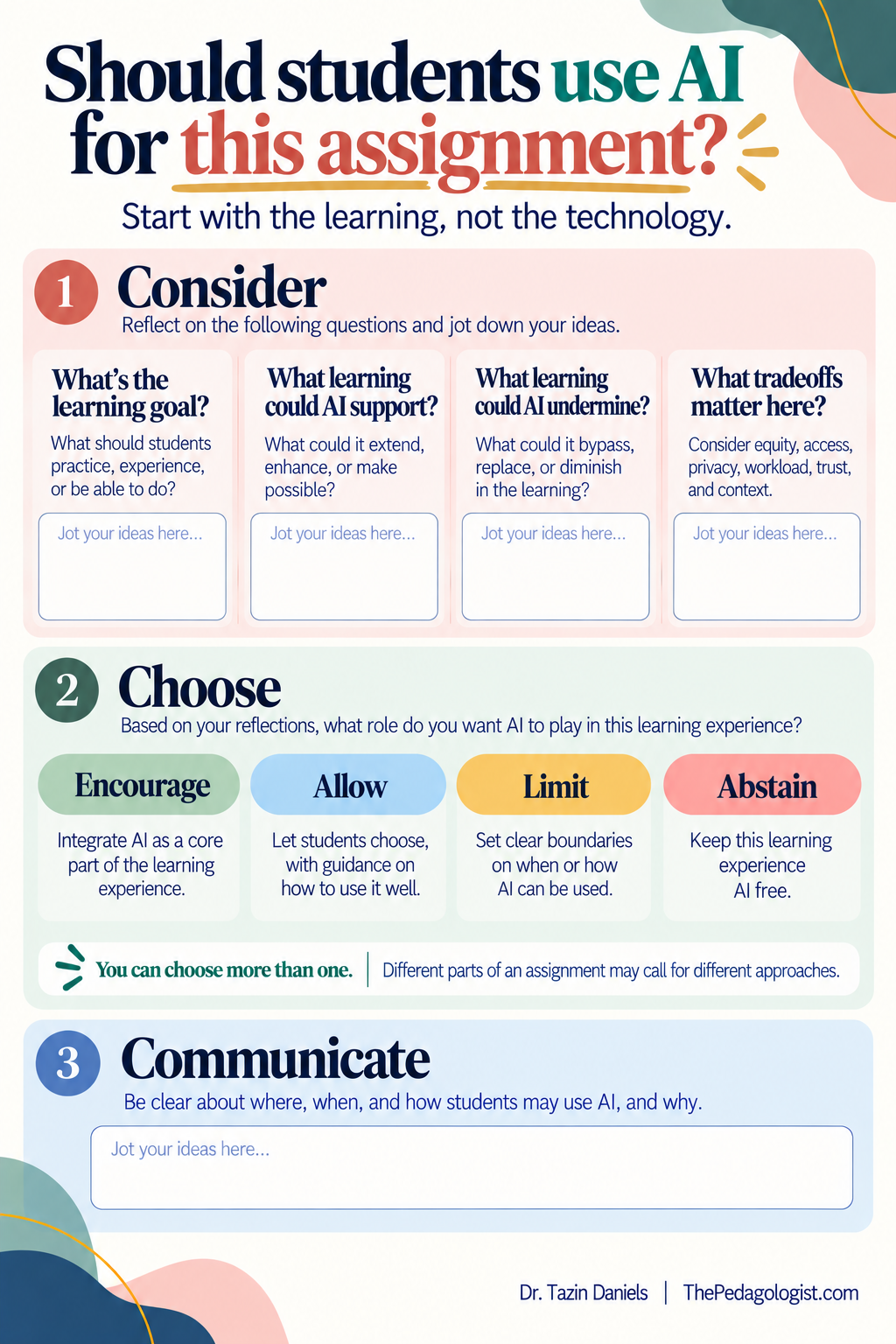
Helping educators and institutions make informed, values-aligned decisions about
whether, when, and how to use generative AI in teaching and learning.
The Faculty Critical Engagement Framework
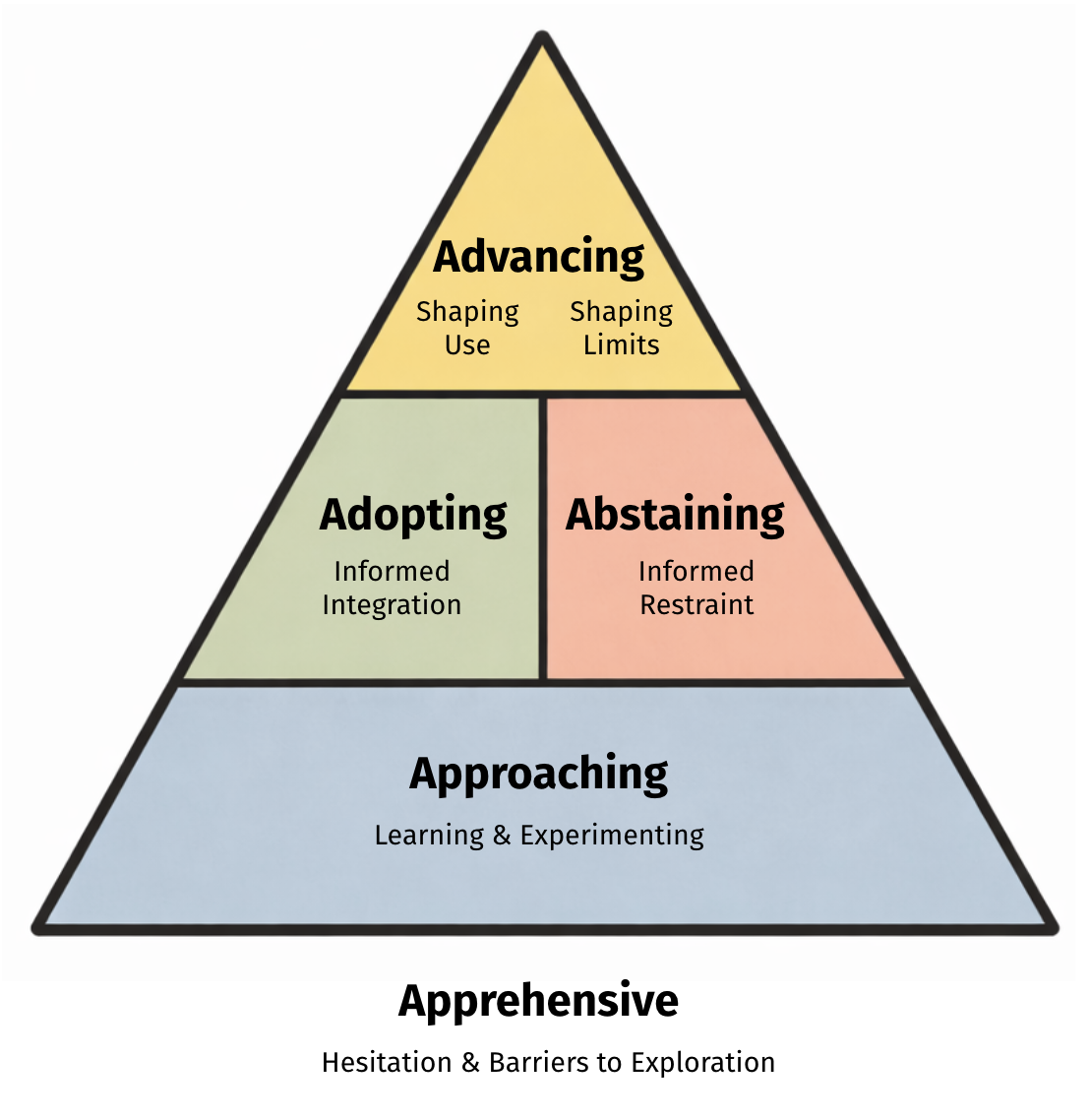
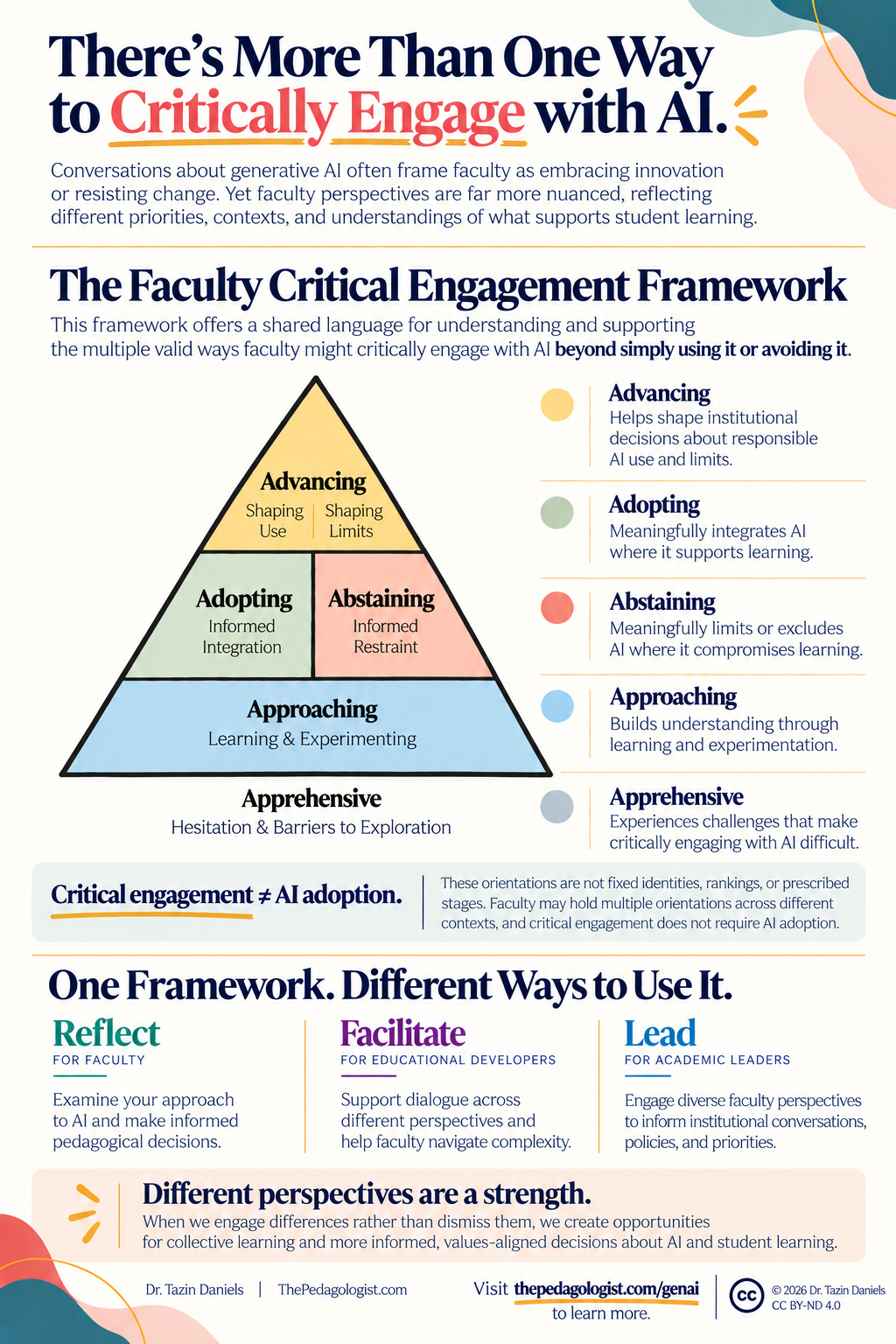
The Faculty Critical Engagement Framework offers a shared language for understanding the different ways educators engage with generative AI. Rather than treating adoption as a measure of progress, it recognizes that thoughtful engagement can take many forms, including exploration, informed integration, informed restraint, and efforts to shape how AI is used, limited, and governed.
Designed for faculty, educational developers, and academic leaders, the framework supports reflection, dialogue, and strategic planning that honor diverse perspectives while remaining grounded in educational goals, disciplinary contexts, and institutional values.
These orientations are not fixed categories or a prescribed progression. Faculty may hold multiple orientations simultaneously or move among them depending on their teaching goals, disciplinary contexts, and experiences.
A Framework for Understanding, Not Prescribing.
The framework creates space for collective sense-making, helping educators and institutions understand different perspectives, navigate tensions, and make informed decisions about AI.
What this framework is…
A planning tool
A way to center teaching values
A shared language for collective-sense making
An affirmation of informed use and non-use
What this framework is not…
A ranking or maturity model
A mandate to adopt AI
A measure of faculty effectiveness
A prediction of where faculty should end up
Explore the Five Orientations
-
Faculty who experience hesitation or encounter barriers that make it difficult to explore generative AI and its implications for teaching and learning. These may include uncertainty, limited time, competing priorities, inadequate support, or unclear institutional expectations.
Apprehension does not necessarily indicate opposition to AI or a lack of knowledge. Faculty may recognize AI's influence on their students and teaching while feeling uncertain about how to respond or lacking the conditions needed to explore their options.
-
Faculty who are actively exploring generative AI to better understand its capabilities, limitations, and implications for teaching and learning. This may involve experimenting with tools, examining how students use AI, exploring pedagogical possibilities and risks, or discussing emerging questions with colleagues and students.
Exploration does not necessarily signal an intention to adopt AI. Faculty are developing the knowledge and judgment needed to make informed decisions about their teaching practices and the expectations they establish for students.
-
Faculty who make intentional, informed decisions to integrate generative AI into particular teaching and learning contexts, including establishing expectations for student use. Rather than adopting AI simply because it is available or convenient, they consider how its use aligns with learning goals, engage students in discussing its benefits, limitations, and tradeoffs, and design learning experiences that support thoughtful, purposeful use.
Adoption does not mean unrestricted use or assuming AI inherently improves learning. It involves establishing meaningful boundaries, helping students develop the judgment to use AI appropriately, and continually evaluating whether its integration supports the learning it is intended to advance.
-
Faculty who make intentional, informed decisions to limit or prohibit generative AI use in particular teaching and learning contexts, including establishing expectations for students. Rather than ignoring AI or relying solely on restrictive policies, they acknowledge its influence, engage students in discussing the reasons for abstention and the tradeoffs involved, and design learning environments that make working without AI both meaningful and feasible.
Abstention does not indicate resistance, unfamiliarity, or unwillingness to innovate. It can be an active, thoughtful pedagogical approach that protects valued learning experiences while helping students develop the judgment to navigate AI's opportunities and temptations.
-
Faculty who extend their engagement beyond individual teaching decisions to help shape how generative AI is understood, used, evaluated, or governed. This may involve conducting research, mentoring colleagues, developing educational resources, influencing institutional policies, or advocating for changes that support teaching and learning.
Advancing does not necessarily mean promoting greater AI adoption or possessing greater expertise than other faculty. Leadership can involve expanding opportunities, establishing boundaries, challenging assumptions, and shaping the institutional conditions that enable informed, equitable decisions about AI.
See the Framework in Action
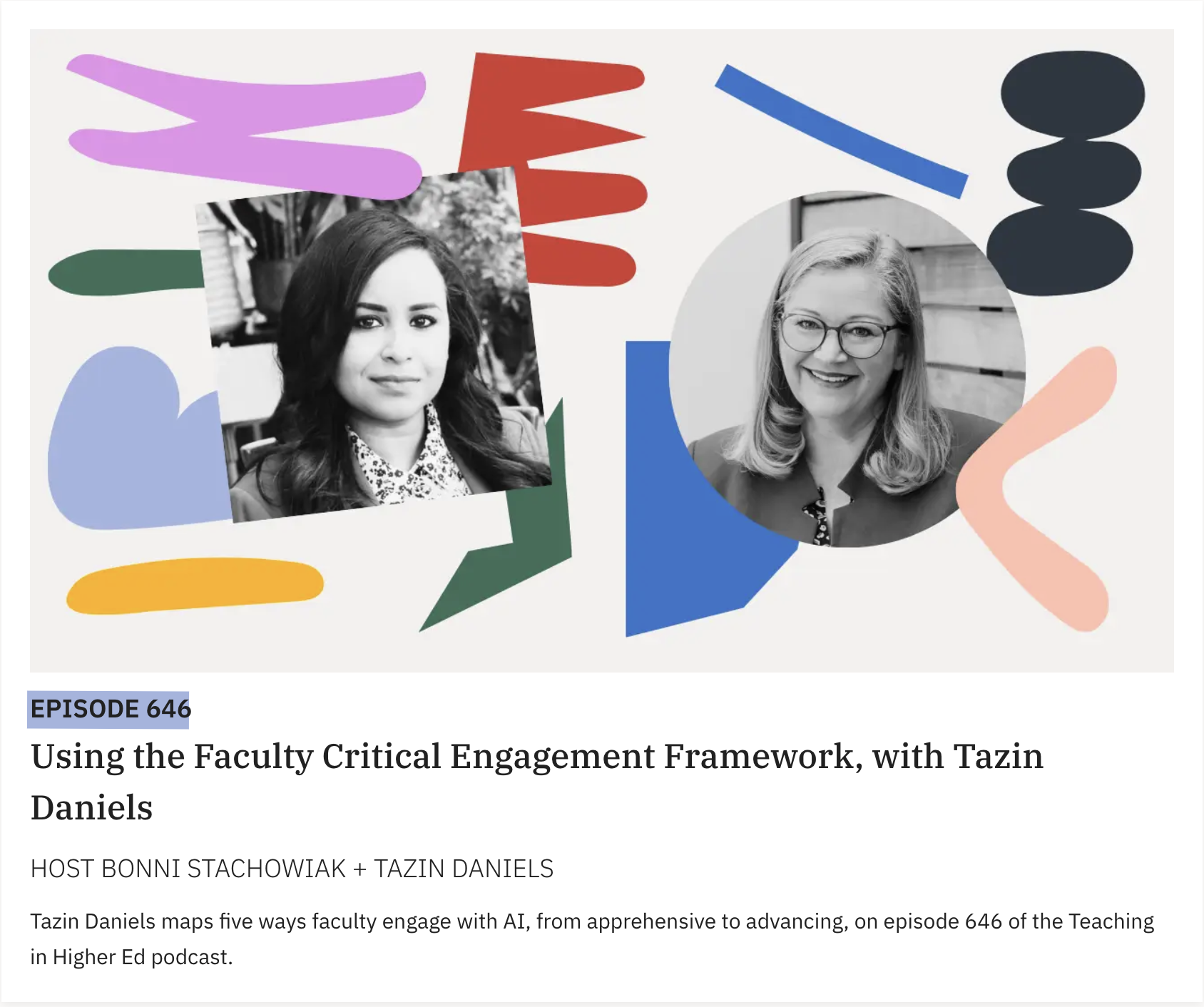
In this February 2026 keynote at the University of Michigan–Dearborn, I introduce the Faculty Critical Engagement Framework and explore how educators can navigate the opportunities, challenges, and tensions of generative AI while staying grounded in their teaching values.

Bring this framework to your campus.
I work with campuses to put the framework into practice, helping educators and leaders navigate differing perspectives, identify shared priorities, and develop approaches aligned with their educational values.
For Faculty
Explore how generative AI intersects with teaching goals and make informed decisions about its role in their courses.
For Academic Leaders
Develop institutional strategies that recognize diverse perspectives and align with campus values and priorities.
For Educational Developers
Design faculty development programs that meet educators where they are and support informed decision-making.
Presentations on Generative AI and Higher Education
(2026) “Finding the Sweet Spot: When to Embrace AI, When to Set Limits, and Why” Workshop for the Public AI Summit for Educations hosted by the Data Nutrition Project and the AI Pedagogy Project, Harvard University.
(2026) “Your Voice Matters: Fostering Faculty Critical Engagement with Generative AI.” Keynote at the “How can Innovation and Integrity Coexist with AI?” symposium at University of Michigan, Dearborn.
(2026) “Your Voice Matters: Fostering Faculty Critical Engagement with Generative AI.” Virtual Keynote for Gustavus Adolphus College.
(2026) “Designing AI Conscious Courses.” Workshop at the AI symposium for Hofstra University.
(2026) “Your Voice Matters: Fostering Faculty Critical Engagement with Generative AI.” Keynote at Whitman College.
(2026) “Recentering Reading & Writing : Addressing Student Shortcuts with Generative AI” Virtual workshop for University of North Carolina, Wilmington.
(2026) “Reading, Writing, and Thinking in the Age of AI.” Virtual workshop for undergraduate students at University of North Carolina, Wilmington.
(2026) “From Resistance to Resilience: A Framework to Empower Faculty Critical Engagement with AI” Plenary for American Conference of Academic Deans (ACAD).
(2026) “Your Voice Matters: Fostering Faculty Critical Engagement with Generative AI.” Keynote for R3 Evolution Summit at Mt. San Antonio College.
(2026) “Your Voice Matters: Fostering Faculty Critical Engagement with Generative AI.” Keynote for the Spring Institute at Texas Southern University.
(2026) “Generative AI and Undergraduate Education” Panel presenter at the Provost’s Seminar on Teaching at the University of Michigan.
(2025) “Your Voice Matters: Fostering Faculty Critical Engagement with Generative AI.” Virtual Keynote for the Virtual AI summit at Northern Virginia Community College (NOVA).
(2025) “Meeting Faculty Where They Are: A Flexible and Scalable Framework for Faculty Professional Development in Generative AI” Plenary at the AAC&U Institute for AI, Pedagogy and the Curriculum.
Explore More Resources